
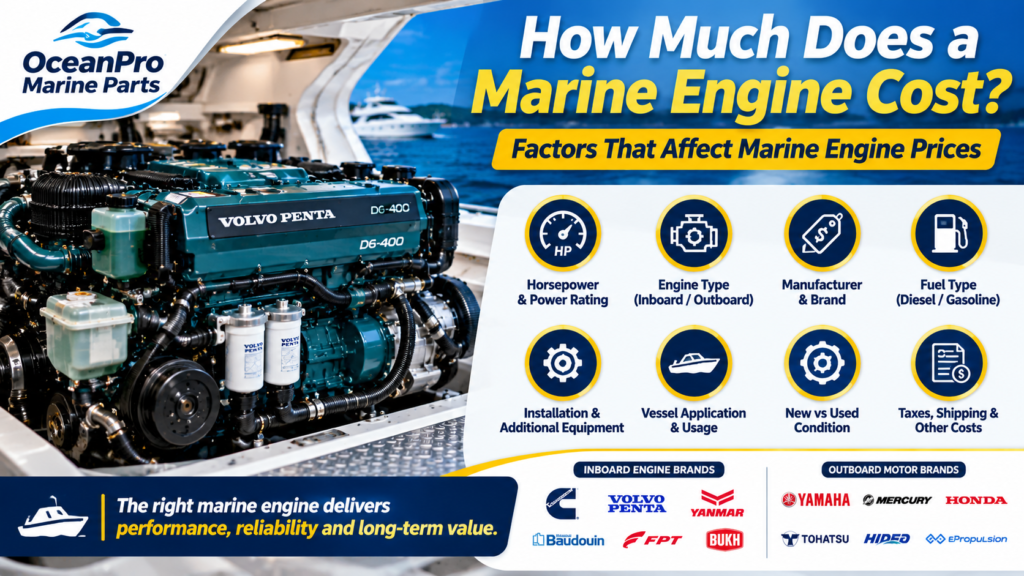
Purchasing a marine engine is a significant investment for any boat owner, commercial vessel operator, or marine equipment buyer. Whether you are replacing an existing engine, upgrading your vessel, or purchasing a new boat, understanding marine engine costs is essential before making a decision.
Marine engine prices vary considerably depending on engine type, horsepower, manufacturer, technology, intended application, and installation requirements. A compact outboard motor designed for a small recreational boat will have different pricing considerations from a high-powered marine diesel engine intended for a commercial vessel.
However, the initial purchase price is only one part of the overall investment. Installation, marine gearboxes, propulsion components, electrical systems, maintenance requirements, and replacement parts can also influence the total cost of acquiring and operating a marine engine.
In this guide, we examine the factors that affect marine engine prices, compare different engine categories, explain additional purchasing costs, and outline what buyers should consider when requesting a marine engine quotation.
Whether you are looking for a Cummins marine engine, Volvo Penta diesel engine, Yanmar marine engine, Yamaha outboard, Mercury outboard, or another propulsion solution, understanding these factors can help you make a more informed purchasing decision.
1. How Much Does a Marine Engine Cost?
There is no single price for a marine engine because the market includes a wide range of engine configurations, power ratings, manufacturers, and applications.
The cost of a marine engine depends primarily on its technical specifications and intended use.
For example, the following categories have different purchasing considerations:
- Small recreational outboard motors.
- High-horsepower outboard engines.
- Inboard gasoline marine engines.
- Inboard diesel marine engines.
- Commercial marine propulsion engines.
- Heavy-duty marine diesel engines.
- Electric outboard motors.
- Auxiliary marine engines.
A buyer searching for a marine engine for a small fishing boat will have different requirements from a commercial operator sourcing a propulsion engine for a passenger vessel.
Consequently, comparing prices without considering engine specifications can lead to inaccurate purchasing decisions.
When evaluating marine engine quotations, compare engines with similar horsepower ratings, duty classifications, configurations, included equipment, and warranty conditions.
2. Engine Type: Inboard vs Outboard Marine Engine Prices
One of the most important factors influencing marine engine costs is the type of propulsion system.
Inboard and outboard engines have different construction arrangements, installation requirements, and supporting components.
Inboard Marine Engines
Inboard engines are installed inside the vessel and transfer power through a propulsion arrangement that may include a marine gearbox, propeller shaft, and propeller.
They are commonly used in yachts, commercial fishing vessels, passenger boats, workboats, and larger recreational vessels.
Popular inboard marine engine manufacturers include:
- Cummins Marine Engines
- Volvo Penta Marine Engines
- Yanmar Marine Engines
- Baudouin Marine Engines
- FPT Marine Engines
- Bukh Marine Engines
When comparing inboard engine prices, consider the engine’s power rating, fuel type, cooling arrangement, duty classification, and whether the quotation includes a gearbox or other accessories.
Some engines are supplied as standalone propulsion units, while others may be offered as part of a more complete propulsion package.
Outboard Marine Engines
Outboard motors are mounted externally, usually on the transom of a boat. They combine the engine and major propulsion components into an integrated assembly.
They are widely used for fishing boats, recreational vessels, inflatable boats, and smaller commercial applications.
Popular outboard manufacturers include:
- Yamaha
- Mercury
- Honda
- Tohatsu
- Hidea
- ePropulsion
Outboard motor prices are influenced by horsepower, engine technology, fuel type, steering configuration, shaft length, electronic features, and manufacturer.
A conventional gasoline-powered outboard and an electric outboard motor may also have different purchasing and ownership cost structures.
3. How Horsepower Affects Marine Engine Prices
Horsepower is one of the most visible factors buyers consider when comparing marine engines.
Generally, higher-powered engines require more substantial engineering, larger components, and greater performance capabilities. These factors can influence their purchase price.
However, horsepower alone does not determine the cost or suitability of a marine engine.
Consider the following power-related factors:
Engine Power Rating
Marine engines are available across a broad range of horsepower ratings.
Smaller engines are often designed for lightweight recreational vessels, while higher-powered engines may be intended for larger boats, yachts, and commercial marine applications.
Continuous and Intermittent Ratings
Marine engines may be offered with different power ratings depending on their intended operating duty.
An engine designed for continuous operation under a specified load may have different engineering and pricing considerations from one designed for intermittent or recreational use.
Always compare the approved power rating and duty classification rather than looking at the maximum horsepower figure alone.
Vessel Requirements
The engine must match the vessel’s approved power range, displacement, expected loading, and propulsion requirements.
Selecting an engine with excessive horsepower can introduce unnecessary purchasing and installation costs.
An undersized engine may also fail to provide the required operating performance.
The correct choice should follow the vessel manufacturer’s specifications and the engine manufacturer’s recommendations.
4. How Marine Engine Brand and Manufacturer Affect Price
The manufacturer is another important consideration when evaluating marine engine prices.
Established marine engine brands may offer different technologies, engineering designs, product ranges, service documentation, and support arrangements.
These differences can influence purchasing costs.
Cummins Marine Engines
Cummins manufactures diesel engines for recreational and commercial marine applications.
Its marine engine range includes different power configurations designed for various vessel types and operating requirements.
When comparing Cummins marine engine prices, consider the exact model, power rating, duty classification, included accessories, and installation requirements.
Volvo Penta Marine Engines
Volvo Penta develops marine propulsion systems and engines for recreational and commercial vessels.
Depending on the model, purchasing considerations may include engine configuration, propulsion package, electronic controls, and associated equipment.
Yanmar Marine Engines
Yanmar produces marine diesel engines used in sailing yachts, motorboats, and commercial marine applications.
Engine specifications, power ratings, cooling arrangements, and intended applications influence the cost of individual models.
Baudouin Marine Engines
Baudouin provides diesel engine solutions for commercial and industrial marine applications.
When assessing a Baudouin marine engine, buyers should consider its approved operating duty, installation requirements, and propulsion compatibility.
FPT Marine Engines
FPT develops diesel engines for different marine propulsion applications.
Its products should be compared according to their technical specifications, power ratings, and intended vessel applications.
Yamaha, Mercury, Honda and Tohatsu Outboards
These manufacturers offer different outboard engine technologies and horsepower categories.
Their pricing can vary according to engine size, model generation, electronic features, steering arrangements, and equipment included with the motor.
The most expensive manufacturer is not automatically the best choice. The appropriate engine is the one that meets the vessel’s requirements and offers suitable long-term support.
5. New vs Used Marine Engine Prices
Another important purchasing decision is whether to buy a new or used marine engine.
Both options have advantages, but their overall costs and risks differ.
Buying a New Marine Engine
A new marine engine provides an opportunity to select a specific model and configuration according to your vessel’s requirements.
Potential advantages include:
- New engine components.
- Manufacturer-specified operating condition.
- Access to applicable manufacturer warranty coverage.
- Current technical documentation.
- Greater certainty about the engine’s previous operating history.
- Easier specification matching when purchasing a complete replacement.
However, new engines may require a higher initial investment.
Buyers should also confirm the warranty terms, installation requirements, delivery arrangements, and equipment included in the quotation.
Buying a Used Marine Engine
A used marine engine may have a lower initial purchase cost, but its condition requires careful evaluation.
Important inspection considerations include:
- Total operating hours.
- Maintenance and service records.
- Previous operating conditions.
- Oil condition and possible contamination.
- Cooling system condition.
- Fuel injection system condition.
- Compression or other appropriate mechanical test results.
- Signs of corrosion.
- Evidence of overheating.
- Availability of replacement parts.
A used engine with incomplete maintenance records or unknown operating history can introduce significant additional costs.
Before purchasing, arrange an inspection by a qualified marine technician and verify the engine’s identity and technical specifications.
Reconditioned and Remanufactured Marine Engines
Reconditioned and remanufactured engines may provide another purchasing option.
However, these terms should not be treated as interchangeable.
The work completed, components replaced, testing procedures, and warranty coverage can differ considerably between suppliers.
Request documentation explaining exactly what has been inspected, repaired, replaced, or tested before comparing quotations.
6. Additional Costs When Purchasing a Marine Engine
The engine purchase price does not always represent the total cost of installing a functional propulsion system.
Depending on the vessel and engine configuration, additional equipment and services may be required.
Marine Gearbox
Many inboard propulsion systems require a compatible marine gearbox to transfer engine power to the propeller shaft.
The gearbox must match the engine’s power and torque characteristics, operating speed, and approved reduction ratio.
If a gearbox is not included in the engine quotation, it should be considered separately.
Propeller and Shaft System
Shaft-driven inboard installations may require a compatible propeller, propeller shaft, bearings, seals, and associated components.
These parts must be selected according to the vessel’s propulsion design.
Engine Mounting and Installation
Installing a replacement inboard engine may require:
- Engine mounts.
- Mounting brackets.
- Shaft alignment.
- Exhaust connections.
- Cooling system connections.
- Fuel system connections.
- Electrical integration.
- Control system installation.
The amount of installation work depends on whether the new engine replaces an existing model or requires modifications to the vessel.
Electrical and Electronic Equipment
Modern marine engines may use electronic monitoring systems, engine control units, sensors, displays, and other electrical components.
Confirm whether the required equipment is included in the quotation.
Transportation and Delivery
Marine engines can be heavy and may require specialized handling and transportation.
Delivery costs can depend on the engine’s dimensions, weight, shipping destination, packaging requirements, and transport arrangements.
International buyers should also account for applicable customs procedures, import duties, and taxes.
Commissioning and Testing
After installation, some engines require commissioning procedures and operational checks.
These may include alignment verification, cooling system inspection, control system checks, and testing under appropriate operating conditions.
Commissioning should follow the engine manufacturer’s requirements.
7. Diesel vs Gasoline Marine Engine Prices
Fuel type can also influence the initial purchase price and long-term operating costs of a marine engine.
Diesel and gasoline marine engines have different engineering characteristics, maintenance requirements, and typical applications.
Marine Diesel Engines
Diesel engines are widely used in commercial vessels, larger yachts, workboats, and other applications requiring suitable marine propulsion systems.
Factors influencing diesel engine costs include:
- Engine displacement.
- Cylinder configuration.
- Turbocharging and fuel injection technology.
- Power rating.
- Duty classification.
- Cooling system design.
- Electronic engine management.
- Manufacturer and model.
Diesel engines may be suitable for demanding operating profiles, but the correct model must be selected according to the vessel’s requirements.
Gasoline Marine Engines
Gasoline engines are common in recreational boats and many outboard applications.
Their pricing depends on horsepower, engine configuration, fuel injection technology, manufacturer, and available features.
When comparing gasoline marine engines, consider the vessel’s fuel system requirements, intended operating conditions, maintenance needs, and manufacturer recommendations.
Which Is More Economical?
Neither diesel nor gasoline propulsion is automatically more economical in every situation.
The overall cost depends on the engine purchase price, fuel consumption, annual operating hours, maintenance, fuel availability, and vessel application.
For commercial operators, evaluating expected operating hours and fuel consumption across the vessel’s duty cycle can provide a more meaningful comparison than looking at the initial purchase price alone.
8. How Marine Engine Condition and Technology Influence Prices
Marine engines with different technological features and equipment configurations may have different purchasing costs.
When comparing models, consider the following:
Fuel Injection Technology
Fuel injection systems influence engine operation, combustion, and performance.
Modern electronic fuel injection systems may offer different control and monitoring capabilities compared with older mechanical arrangements.
Turbocharging
Turbocharged engines use exhaust-driven compressors to increase the amount of air supplied to the engine.
Their design and associated components can influence engine specifications, maintenance requirements, and purchasing costs.
Cooling System Design
Marine engines may use different cooling arrangements depending on their design and application.
These may include raw-water cooling or closed-circuit freshwater cooling with a heat exchanger.
The cooling system configuration and associated equipment should be included when comparing engine specifications.
Electronic Monitoring and Controls
Some modern marine engines incorporate electronic control units, digital displays, monitoring systems, and integrated control interfaces.
Buyers should confirm which electronic components are included and whether additional vessel integration equipment is required.
Emissions and Regulatory Requirements
Applicable emissions standards and marine regulations may influence engine selection and equipment configuration.
The relevant requirements depend on the vessel’s intended use, operating jurisdiction, and applicable regulations.
An engine should comply with the requirements governing its intended installation and operation.
9. How to Compare Marine Engine Quotations
Receiving multiple quotations can help you evaluate available marine engine options.
However, comparing quotations based only on the final price can be misleading.
Two engines with similar horsepower ratings may have different equipment packages, duty classifications, warranty conditions, and installation requirements.
Use the following checklist when reviewing quotations.
| Comparison factor | What to verify |
|---|---|
| Manufacturer | Confirm the engine manufacturer |
| Engine model | Verify the exact model number |
| Horsepower | Check the approved power rating |
| Engine configuration | Inboard, outboard, diesel, gasoline, or electric |
| Duty classification | Confirm the intended operating duty |
| Included accessories | Identify what is supplied with the engine |
| Gearbox | Confirm whether a compatible gearbox is included |
| Warranty | Review coverage and conditions |
| Documentation | Check technical and installation documentation |
| Delivery | Confirm shipping and delivery arrangements |
| Installation | Determine whether installation is included |
| Spare parts | Consider replacement part availability |
A detailed comparison helps identify the actual value of each offer and reduces the likelihood of unexpected purchasing costs.
10. How to Reduce Marine Engine Purchasing Costs Without Compromising Quality
Purchasing a marine engine does not necessarily mean choosing the most expensive model.
The objective should be to identify an engine that satisfies the vessel’s technical requirements while avoiding unnecessary equipment and operating expenses.
Consider the following approaches.
Select the Correct Engine Power
Avoid purchasing an engine with a power rating that exceeds the vessel’s approved requirements.
An appropriately rated engine can help avoid unnecessary initial investment and compatibility problems.
Compare Equivalent Engine Models
Request quotations for engines with comparable horsepower, duty ratings, configurations, and included equipment.
This makes price comparisons more meaningful.
Check Replacement Part Availability
Consider the availability of genuine filters, impellers, belts, gaskets, and other maintenance components.
An engine with difficult-to-source replacement parts may introduce additional operating challenges.
Evaluate Long-Term Operating Costs
Look beyond the initial purchase price.
Compare expected fuel consumption, maintenance intervals, servicing requirements, and equipment support over the expected ownership period.
Confirm Compatibility Before Ordering
Purchasing an incompatible engine can result in expensive modifications or additional equipment requirements.
Verify vessel specifications, engine dimensions, gearbox compatibility, and installation arrangements before placing an order.
11. Where to Buy Marine Engines and Request a Quotation
Finding a suitable marine engine supplier is an important step when purchasing propulsion equipment.
Whether you are looking for an inboard diesel engine, an outboard motor, or a replacement engine for a commercial vessel, selecting the correct equipment requires accurate technical information.
OceanPro Marine Parts provides access to marine equipment categories covering marine engines, outboard motors, generators, gearboxes, propulsion systems, and associated spare parts.
Buyers can explore equipment options from established marine manufacturers, depending on product availability and the specific requirements of their applications.
What Information Should You Provide When Requesting a Quote?
To help identify a suitable marine engine, prepare the following information:
- Vessel type: Fishing boat, yacht, commercial vessel, passenger boat, or recreational boat.
- Existing engine: Manufacturer, model, and serial number, where available.
- Required horsepower: The vessel’s approved engine power range.
- Engine configuration: Inboard or outboard.
- Fuel type: Diesel, gasoline, or electric.
- Application: Recreational, commercial, auxiliary, or replacement.
- Installation requirements: Relevant dimensions, gearbox details, and other technical information.
Providing these details makes it easier to assess compatibility and identify suitable equipment.
Explore Marine Engines at OceanPro Marine Parts
Visit https://oceanpromarineparts.com/ to explore marine engines, outboard motors, generators, gearboxes, propulsion equipment, and spare parts.
For product enquiries and quotation requests, contact:
Email: support@oceanpromarineparts.com
Frequently Asked Questions
1. How much does a marine engine cost?
Marine engine prices vary according to horsepower, engine configuration, manufacturer, technology, and intended application. Small recreational outboards, high-powered outboards, and commercial diesel propulsion engines have different purchasing requirements. Requesting a quotation based on your vessel’s specifications is the most reliable way to establish the cost.
2. What is the most expensive type of marine engine?
High-powered marine diesel engines designed for demanding commercial, industrial, or large-vessel applications can involve substantial engineering and equipment requirements. However, the actual cost depends on the specific model, power rating, configuration, and included equipment.
3. Are diesel marine engines more expensive than gasoline engines?
Diesel marine engines can have higher initial purchasing costs in some categories because of their design and construction. However, pricing varies considerably between engine models and power ratings. Buyers should also compare fuel consumption, maintenance, and expected operating hours.
4. Does horsepower affect marine engine prices?
Yes. Higher-powered engines often require larger and more complex components, which can influence their prices. However, manufacturer, engine technology, duty classification, and configuration also affect the final cost.
5. Is it cheaper to buy a used marine engine?
A used marine engine may have a lower initial purchase price, but its condition, operating hours, maintenance history, and remaining service life must be evaluated. Repairing an engine with hidden mechanical problems can increase its total ownership cost.
6. Does a marine engine price include the gearbox?
Not always. Some inboard marine engines are sold separately from the gearbox, while other quotations may include a complete propulsion package. Always confirm which components are included before comparing prices.
7. What additional costs should I consider when buying a marine engine?
Additional costs may include installation, marine gearboxes, propellers, shafts, electrical equipment, controls, transportation, commissioning, and applicable taxes or import charges.
8. How do I choose the right marine engine for my budget?
Start with the vessel manufacturer’s approved power requirements and identify suitable engine configurations. Compare equivalent models, included equipment, warranty conditions, spare parts availability, and long-term operating costs before making a purchasing decision.
9. Where can I get a quotation for a marine engine?
You can explore marine equipment at OceanPro Marine Parts through https://oceanpromarineparts.com/ or contact support@oceanpromarineparts.com with your vessel and engine specifications to discuss your requirements.
Conclusion
Understanding marine engine costs requires more than comparing the advertised prices of different engine models.
Horsepower, engine configuration, manufacturer, fuel type, technology, installation requirements, and additional propulsion equipment all influence the overall purchasing investment.
Whether you need a compact outboard motor for a recreational fishing boat or a high-powered diesel engine for a commercial vessel, selecting equipment that matches your technical requirements is essential.
Before purchasing, compare detailed quotations, verify compatibility, investigate replacement part availability, and consider the long-term operating costs of the engine.
Explore marine engines, outboard motors, generators, gearboxes, and marine spare parts at OceanPro Marine Parts to identify equipment suitable for your vessel and request a quotation for your next marine project.