
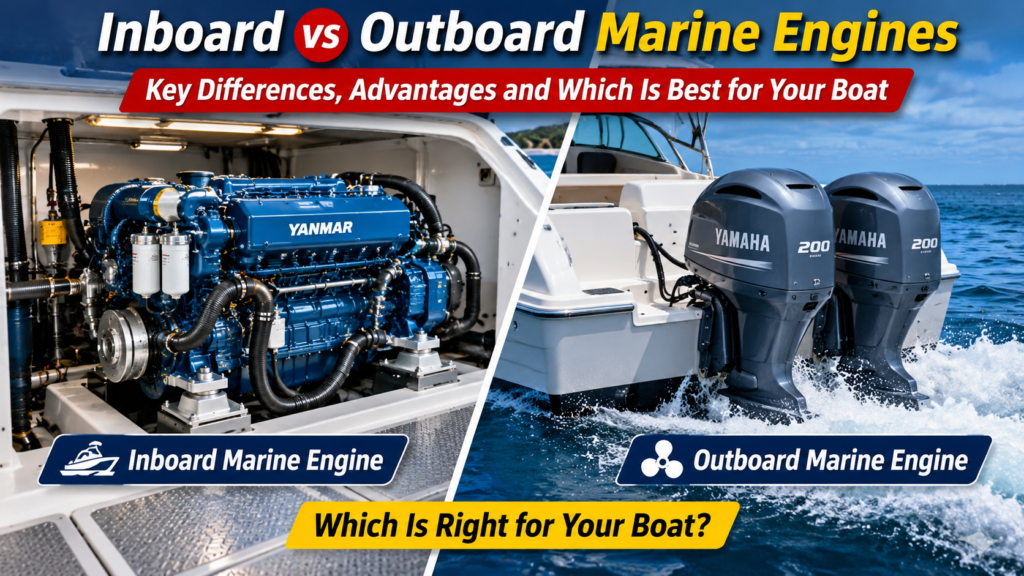
Choosing between an inboard and an outboard marine engine is an important decision when purchasing a boat, replacing an existing engine, or upgrading a vessel’s propulsion system. Both configurations offer distinct advantages, but their differences in installation, performance, maintenance, onboard space, and operating requirements can significantly influence your decision.
Inboard marine engines are installed inside the vessel and typically transfer power through a shaft or another integrated propulsion arrangement. Outboard motors, on the other hand, are mounted externally at the transom and combine the engine, gearbox, and propeller into one compact unit.
Understanding how these systems work and where each performs best can help you identify the right solution for your vessel.
Whether you operate a fishing boat, recreational vessel, yacht, passenger boat, or commercial marine vessel, this guide explores the key differences between inboard and outboard marine engines, their advantages, limitations, and the factors to consider before making a purchase.
1. What Is an Inboard Marine Engine?
An inboard marine engine is installed inside the hull of a vessel, usually within a dedicated engine compartment. Unlike an outboard motor, the engine itself is not mounted externally at the transom.
Power is transferred through a propulsion arrangement that typically includes a marine gearbox, propeller shaft, and propeller. Depending on the vessel’s design, inboard engines may also operate with approved alternative propulsion arrangements.
Inboard marine engines are commonly used in larger recreational boats, yachts, fishing vessels, passenger boats, and commercial marine applications.
They are available in different power configurations, including diesel and gasoline engines, although diesel models are widely used in commercial and larger marine applications.
Popular Inboard Marine Engine Manufacturers
Several established manufacturers produce engines for different vessel types and operating requirements.
- Cummins Marine Engines: Known for marine diesel engine solutions used in recreational and commercial vessels.
- Volvo Penta Marine Engines: Offers marine propulsion systems and engines for various recreational and commercial applications.
- Yanmar Marine Engines: Produces marine diesel engines used in sailing yachts, motorboats, and commercial vessels.
- Baudouin Marine Engines: Provides diesel engine solutions for demanding commercial and industrial marine applications.
- FPT Marine Engines: Develops marine diesel propulsion engines for different vessel categories.
- Bukh Marine Engines: Offers compact marine diesel engines for smaller vessels and auxiliary applications.
The suitability of any particular engine depends on its power rating, duty classification, installation requirements, and compatibility with the vessel.
2. What Is an Outboard Marine Engine?
An outboard marine engine is a self-contained propulsion unit mounted externally, normally on the transom of a boat.
Unlike most inboard arrangements, an outboard combines the engine, gearbox, drive shaft, propeller, and steering mechanism into a single assembly.
This configuration makes installation and removal relatively straightforward when compared with many traditional inboard systems.
Outboard motors are widely used in fishing boats, recreational boats, inflatable boats, smaller passenger vessels, and certain commercial marine applications.
They are available in different power ratings, fuel configurations, and technologies, including conventional gasoline-powered models and electric outboard motors.
Popular Outboard Marine Engine Manufacturers
Some well-known manufacturers in the outboard engine market include:
- Yamaha Outboard Engines: Offers a broad range of outboard motors for recreational and commercial applications.
- Mercury Outboard Engines: Produces outboard propulsion systems for different boat sizes and performance requirements.
- Honda Outboard Engines: Known for four-stroke outboard motors designed for recreational and commercial boating.
- Tohatsu Outboard Engines: Manufactures compact and higher-powered outboard motors for various vessel applications.
- Hidea Outboard Engines: Offers gasoline-powered outboard motors across different horsepower categories.
- ePropulsion: Develops electric marine propulsion solutions for applications where electric operation is suitable.
When comparing these manufacturers, consider the specific model, horsepower, fuel requirements, intended application, service support, and compatibility with your boat.
3. Key Differences Between Inboard and Outboard Marine Engines
Although both systems provide propulsion, their construction and installation arrangements are significantly different.
Understanding these differences makes it easier to determine which configuration is appropriate for your vessel.
Installation and Positioning
The most obvious difference is where each engine is installed.
An inboard engine is positioned inside the vessel, generally in an engine compartment. Its installation involves mounting the engine securely, connecting the gearbox and propulsion components, and ensuring correct shaft alignment where a shaft-drive arrangement is used.
An outboard motor is mounted externally at the transom. Its integrated design combines several propulsion components into one unit.
This makes outboard installations particularly suitable for vessels designed around transom-mounted propulsion.
Available Onboard Space
Inboard engines occupy space within the hull, which may reduce the available room for storage or other onboard equipment.
However, their installation can be appropriate for larger vessels with dedicated engine compartments.
Outboard motors are positioned outside the main hull space, potentially allowing more room inside the boat.
This can be beneficial for smaller fishing and recreational vessels where onboard space is limited.
Maintenance and Accessibility
Outboard motors are generally accessible because their major components are contained within an externally mounted assembly.
Routine inspection and servicing can often be performed without accessing an enclosed engine compartment.
Inboard engines may require access through engine-room panels or dedicated maintenance spaces. Their associated systems, including gearboxes, shafts, cooling circuits, and exhaust arrangements, can introduce additional maintenance considerations.
However, maintenance requirements depend on the engine model, installation quality, operating hours, and manufacturer’s service recommendations.
Propulsion and Handling
Inboard engines commonly transmit power through a fixed propulsion arrangement, such as a shaft and propeller. Their handling characteristics depend on the vessel’s hull, rudder arrangement, propeller configuration, and overall design.
Outboard motors provide steering by turning the entire propulsion unit. This can offer responsive manoeuvrability, particularly on smaller vessels.
Neither configuration is automatically superior in every operating condition. The best choice depends on the vessel’s intended use and propulsion design.
4. Advantages of Inboard Marine Engines
Inboard engines remain an important choice for larger boats and vessels that require integrated propulsion arrangements.
Some of their main advantages include:
Suitable for Larger Vessels
Inboard marine engines are commonly installed in yachts, commercial fishing vessels, passenger boats, and other larger vessels.
Their design allows manufacturers and boatbuilders to integrate the engine and propulsion system into the vessel’s overall engineering arrangement.
Suitable for High-Power Applications
Many inboard diesel engines are available in power ratings suitable for demanding commercial and recreational applications.
They can be configured for different operating profiles, including continuous-duty applications, depending on the engine’s approved rating.
Integrated Propulsion Systems
Inboard engines can be connected to marine gearboxes, shafts, propellers, and other propulsion components designed for the vessel.
This arrangement is particularly useful where a dedicated propulsion system is required.
Engine Protection and Installation
Because the engine is installed within the hull, it is generally protected from direct exposure to external water, waves, and physical impacts.
However, the engine compartment must be appropriately designed for ventilation, cooling, drainage, fire protection, and access.
Suitable for Commercial Operations
Inboard diesel engines are widely used in commercial marine applications because suitable models can provide the power and duty ratings required for demanding operating schedules.
Their suitability must always be assessed against the vessel’s propulsion requirements and the manufacturer’s specifications.
5. Advantages of Outboard Marine Engines
Outboard motors offer several practical benefits, particularly for recreational vessels, fishing boats, and smaller commercial boats.
Easier Installation and Replacement
Outboard motors are generally easier to install or replace than many traditional inboard engine arrangements.
Their integrated construction reduces the need for separate engine-room installations, although transom strength, mounting dimensions, steering, fuel systems, and electrical connections must still be checked.
More Available Interior Space
Since the motor is mounted externally, it does not occupy the same internal engine-compartment space as an inboard engine.
This can create more room for passengers, equipment, fishing activities, and storage.
Convenient Servicing Access
Many routine maintenance procedures can be performed with the outboard accessible at the transom.
Depending on the model, the motor may also be tilted out of the water when the vessel is not in use, following the manufacturer’s recommendations.
Manoeuvrability
Outboard motors steer by rotating the propulsion unit, which can provide responsive handling and manoeuvrability.
This is particularly useful for fishing boats, smaller recreational vessels, and boats operating in areas where frequent directional changes are required.
Multiple Engine Configurations
Some vessels can accommodate two or more outboard motors.
Multiple-engine installations can provide additional available power and, where appropriately designed, propulsion redundancy.
However, the vessel must be engineered and rated for the combined installation.
6. Inboard vs Outboard Marine Engines: Technical Comparison
The following table summarizes the main differences between the two configurations.
| Comparison factor | Inboard engine | Outboard motor |
|---|---|---|
| Installation | Inside the vessel | Mounted externally |
| Propulsion | Usually separate shaft or integrated drive system | Integrated propulsion unit |
| Internal space | Requires engine compartment | Frees up interior engine space |
| Steering | Usually separate steering arrangement | Entire unit rotates |
| Maintenance access | Depends on engine-room access | Often easier external access |
| Engine replacement | Can involve extensive installation work | Generally simpler |
| Common fuel types | Diesel and gasoline | Mainly gasoline; electric options available |
| Typical applications | Yachts, commercial boats, larger vessels | Fishing, recreational and smaller commercial boats |
| Multiple-engine options | Available | Available |
| Installation complexity | Often more involved | Often less involved |
The table provides a general comparison. Individual models and vessel designs can differ considerably.
7. Which Marine Engine Is More Fuel Efficient?
Fuel efficiency is an important consideration when choosing a marine engine, particularly for boat owners who operate frequently or cover long distances.
However, it is not accurate to assume that every inboard engine consumes less fuel than every outboard motor, or vice versa.
Fuel consumption depends on several factors, including:
- Engine type and displacement.
- Engine power rating.
- Operating RPM.
- Vessel weight and displacement.
- Hull design and condition.
- Propeller selection.
- Operating speed.
- Engine maintenance condition.
- Fuel type and engine technology.
For example, a properly matched marine diesel inboard engine may be suitable for a commercial vessel operating for extended periods under a relatively consistent load.
A modern four-stroke outboard may offer an efficient solution for a recreational fishing boat operating at varying speeds.
The best way to compare fuel consumption is to examine manufacturer-provided fuel consumption data at relevant engine speeds and loads, then consider the vessel’s actual operating profile.
For commercial operators, evaluating fuel consumption across the expected duty cycle is particularly important.
8. Maintenance Requirements: Inboard vs Outboard
Both inboard and outboard marine engines require regular servicing to maintain reliable operation.
The maintenance procedures, however, differ according to their design and installation.
Inboard Engine Maintenance
Typical maintenance requirements may include:
- Engine oil and oil filter replacement.
- Fuel filter inspection and replacement.
- Cooling system inspection.
- Raw-water pump and impeller servicing.
- Belt and hose inspection.
- Exhaust system inspection.
- Marine gearbox oil checks and servicing.
- Propeller shaft and seal inspection where applicable.
- Battery and electrical system checks.
Inboard installations may also require periodic inspection of engine mounts, alignment, ventilation, and associated propulsion components.
Outboard Motor Maintenance
Typical outboard maintenance procedures include:
- Engine oil and filter replacement where applicable.
- Gearcase lubricant inspection and replacement.
- Water pump and impeller inspection.
- Fuel system inspection.
- Spark plug inspection on applicable gasoline models.
- Propeller inspection.
- Anode inspection and replacement.
- Cooling water passage inspection.
- Steering system inspection.
- Electrical and battery checks.
The exact maintenance schedule depends on the manufacturer, engine model, operating hours, and environmental conditions.
Always follow the manufacturer’s maintenance documentation rather than relying on a universal servicing interval.
9. What Should You Consider Before Choosing an Inboard or Outboard Engine?
Selecting the correct propulsion configuration requires more than comparing engine prices or horsepower ratings.
Before purchasing, evaluate the following factors.
Vessel Type and Size
Start by identifying the vessel’s design, displacement, dimensions, and intended operating conditions.
A small recreational boat may be designed specifically for an outboard installation, while a larger commercial vessel may require an inboard diesel propulsion system.
Required Horsepower
Determine the vessel manufacturer’s approved engine power range.
Consider the vessel’s loading capacity, intended cruising speed, operating conditions, and the engine’s continuous or intermittent power rating.
Avoid selecting an engine based on maximum horsepower alone.
Installation Compatibility
For an inboard engine, check:
- Engine compartment dimensions.
- Engine mounting arrangement.
- Gearbox compatibility.
- Shaft alignment requirements.
- Cooling and exhaust arrangements.
- Electrical and fuel system requirements.
For an outboard motor, check:
- Transom height and strength.
- Engine mounting specifications.
- Recommended horsepower range.
- Steering compatibility.
- Fuel system requirements.
- Engine weight and available mounting capacity.
Operating Costs
Consider fuel consumption, maintenance requirements, replacement components, and servicing support.
A suitable engine should meet your vessel’s operating requirements without creating unnecessary maintenance or operational difficulties.
Spare Parts Availability
Before selecting a manufacturer, investigate the availability of genuine replacement components and maintenance kits.
Access to compatible filters, impellers, belts, gaskets, cooling components, and other service parts is important for maintaining your engine over time.
10. Where Are Inboard and Outboard Marine Engines Commonly Used?
Different vessels are designed around different propulsion configurations.
Understanding typical applications can help narrow down your options.
Commercial Fishing Vessels
Commercial fishing vessels may use either inboard or outboard propulsion, depending on their size, hull design, operating range, and fishing requirements.
Larger vessels commonly use inboard diesel engines, while smaller fishing boats frequently use outboard motors.
Recreational Boats
Outboard motors are widely used in recreational boats because of their compact external installation and manoeuvrability.
However, many larger recreational boats and cruisers use inboard propulsion systems.
Yachts and Motorboats
Both configurations are used in the yacht and motorboat market.
Larger yachts frequently incorporate inboard engines, while smaller motorboats may use outboard motors or alternative propulsion arrangements.
Passenger and Commercial Vessels
Passenger boats, workboats, and other commercial vessels may use inboard diesel engines or outboard motors depending on their operational requirements.
The engine must be selected according to the vessel’s design, passenger capacity, duty cycle, and applicable marine regulations.
11. Popular Marine Engine Brands to Consider
When comparing inboard and outboard propulsion systems, the manufacturer and specific engine model are important considerations.
OceanPro Marine Parts provides a point of reference for exploring marine equipment categories and established manufacturers.
Some manufacturers worth considering include:
Inboard marine engine manufacturers:
- Cummins
- Volvo Penta
- Yanmar
- Baudouin
- FPT
- Bukh
Outboard engine manufacturers:
- Yamaha
- Mercury
- Honda
- Tohatsu
- Hidea
- ePropulsion
Each manufacturer offers different engine technologies, power ratings, configurations, and applications.
Rather than choosing a brand based on reputation alone, compare the specifications of the individual engine models and confirm their compatibility with your vessel.
12. Where to Buy Inboard and Outboard Marine Engines
Finding a suitable marine engine supplier is an important part of the purchasing process.
Whether you need an inboard diesel engine for a commercial vessel or an outboard motor for a recreational boat, it is important to identify equipment that matches your technical requirements.
OceanPro Marine Parts offers a marine equipment selection covering categories such as marine engines, outboard motors, marine generators, gearboxes, propulsion systems, and associated spare parts.
When sourcing a replacement or new engine, provide the following information to help identify compatible options:
- Vessel type and manufacturer.
- Existing engine manufacturer and model.
- Engine serial number, where available.
- Required horsepower.
- Intended operating application.
- Preferred inboard or outboard configuration.
- Relevant installation dimensions.
Providing accurate information helps reduce compatibility problems and makes it easier to identify appropriate equipment.
Explore Marine Engines and Marine Equipment at OceanPro Marine Parts
Visit https://oceanpromarineparts.com/ to explore marine equipment categories and available solutions.
For product enquiries and assistance with your requirements, contact:
Email: support@oceanpromarineparts.com
Frequently Asked Questions
1. Is an inboard or outboard engine better for a boat?
Neither configuration is universally better. Inboard engines are commonly selected for larger vessels and integrated propulsion arrangements, while outboard motors are popular for smaller recreational and fishing boats. The right option depends on vessel design, horsepower requirements, installation compatibility, and intended application.
2. Are inboard marine engines more powerful than outboard motors?
Not necessarily. Both configurations are available across a wide range of power ratings. The appropriate engine depends on the vessel’s approved horsepower range, propulsion requirements, and operating conditions.
3. Are outboard motors easier to maintain?
Outboard motors often provide convenient access to major components because they are externally mounted. However, they still require regular servicing, including cooling system, fuel system, gearcase, and propeller inspections. Maintenance complexity depends on the specific model and installation.
4. Do inboard marine engines use diesel?
Many inboard marine engines use diesel fuel, particularly those designed for larger vessels and commercial applications. However, gasoline-powered inboard engines are also available.
5. Can an inboard engine be replaced with an outboard motor?
In some cases, conversion may be possible, but it is not a straightforward engine replacement. The vessel’s transom strength, hull design, weight distribution, propulsion arrangement, steering, fuel systems, and structural requirements must be assessed by a qualified marine professional.
6. Which engine is better for a fishing boat?
Smaller fishing boats commonly use outboard motors because of their external installation, manoeuvrability, and available power options. Larger commercial fishing vessels often use inboard diesel engines. The vessel’s size, operating range, fishing requirements, and load capacity should determine the selection.
7. How do I choose the correct horsepower for my marine engine?
Start with the vessel manufacturer’s approved horsepower range. Consider vessel displacement, expected loading, intended operating speed, and the engine’s approved power rating. Consult a qualified marine technician or naval architect when evaluating a replacement or modified propulsion system.
8. Where can I buy marine engines and outboard motors?
OceanPro Marine Parts offers marine equipment categories covering engines, outboard motors, generators, gearboxes, propulsion systems, and spare parts. Visit https://oceanpromarineparts.com/ or contact support@oceanpromarineparts.com for enquiries.
Conclusion
Choosing between an inboard and outboard marine engine requires careful consideration of your vessel’s design, operating requirements, installation arrangements, maintenance needs, and long-term operating costs.
Inboard marine engines are commonly suited to larger vessels, integrated propulsion systems, and demanding commercial applications. Outboard motors offer practical advantages for many fishing boats, recreational vessels, and smaller commercial boats.
Ultimately, the right choice is the engine configuration that meets your vessel’s technical specifications and intended operating conditions.
Before making a purchase, compare the available engine models, confirm installation compatibility, and consider the availability of genuine replacement components.
Explore marine engines, outboard motors, generators, gearboxes, and marine spare parts at OceanPro Marine Parts to find equipment suited to your next marine project.