
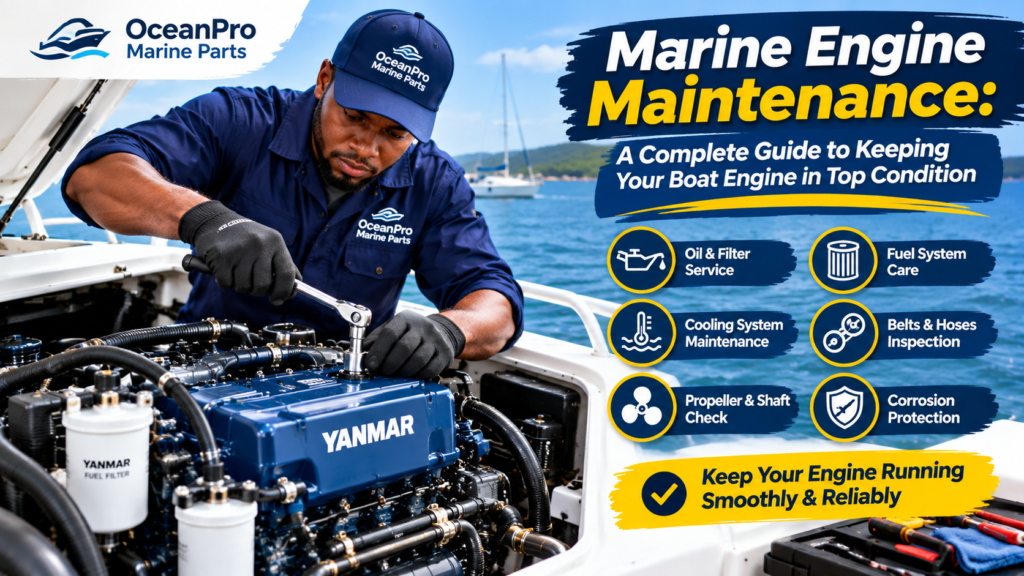
A well-maintained marine engine is essential for reliable vessel operation, consistent performance, and long-term equipment durability. Whether you operate a recreational boat, fishing vessel, yacht, or commercial marine vessel, regular engine maintenance helps reduce the risk of unexpected breakdowns and costly repairs.
Unlike many automotive engines, marine engines operate in demanding environments where saltwater exposure, humidity, vibration, changing loads, and extended operating periods can affect equipment condition. These conditions make preventive maintenance particularly important.
Both inboard marine diesel engines and outboard motors require routine inspections, servicing, and replacement of components according to their manufacturers’ recommendations.
Understanding how to maintain your marine engine can help you identify potential problems early, protect important components, and keep your vessel operating as intended.
In this guide, we explore essential marine engine maintenance procedures, important components to inspect, common problems to watch for, and how to develop an effective maintenance schedule.
1. Why Marine Engine Maintenance Is Important
Marine engines are designed to operate under demanding conditions. Continuous exposure to moisture, temperature changes, vibration, and varying engine loads can gradually affect mechanical and electrical components.
Regular maintenance helps address these operating challenges before they develop into more serious problems.
Some important benefits include:
Improved Engine Reliability
Routine inspections help identify developing problems such as fuel leaks, damaged hoses, cooling system restrictions, loose connections, and abnormal engine noises.
Addressing these issues early can reduce the likelihood of unexpected engine failure.
Better Operating Performance
A properly maintained engine is more likely to operate within its intended performance specifications.
Clean filters, appropriate lubrication, an effective cooling system, and correctly maintained fuel components all contribute to proper engine operation.
Reduced Repair Costs
Preventive maintenance can help identify worn components before they cause damage to other parts of the propulsion system.
Replacing a deteriorating hose or damaged impeller at the appropriate time may help prevent more extensive repairs.
Longer Equipment Service Life
Following the manufacturer’s maintenance recommendations helps protect important engine components and supports long-term equipment durability.
Improved Vessel Readiness
For commercial operators and recreational boat owners, engine reliability is important when planning trips and maintaining vessel availability.
A consistent maintenance programme helps reduce avoidable downtime.
2. Follow the Marine Engine Manufacturer’s Maintenance Schedule
The most important starting point for maintaining any marine engine is understanding the manufacturer’s maintenance requirements.
Different engines have different service intervals, lubrication requirements, replacement components, and inspection procedures.
A Cummins marine diesel engine, for example, may have different maintenance requirements from a Yanmar diesel engine or a Yamaha outboard motor.
Before carrying out maintenance, identify the exact engine model and consult its official service documentation.
Important information includes:
- Recommended engine oil specification.
- Oil and filter replacement intervals.
- Fuel filter servicing requirements.
- Cooling system inspection procedures.
- Water pump and impeller replacement recommendations.
- Valve clearance inspection requirements, where applicable.
- Gearbox or gearcase lubricant specifications.
- Belt and hose inspection requirements.
- Recommended winterization and storage procedures.
Maintenance intervals may be based on operating hours, calendar periods, or both. Operating conditions can also influence servicing requirements.
For example, engines exposed to saltwater, heavy commercial workloads, extended idling, or frequent short operating cycles may require additional attention.
Never assume that all marine engines follow the same servicing schedule.
3. Check and Replace Marine Engine Oil Regularly
Engine oil plays an essential role in protecting internal engine components.
It lubricates moving parts, helps manage operating temperatures, reduces friction, and carries contaminants toward the filtration system.
Insufficient lubrication or unsuitable oil can contribute to premature component wear and mechanical damage.
Why Engine Oil Inspection Matters
Regular oil inspection helps identify potential problems, including:
- Low oil levels.
- Oil leaks.
- Oil contamination.
- Unusual changes in oil appearance.
- Incorrect oil specifications.
- Excessive oil consumption.
Follow the manufacturer’s procedure for checking oil levels. Some engines require specific operating conditions or waiting periods before obtaining an accurate reading.
Choosing the Correct Marine Engine Oil
Always use oil that meets the engine manufacturer’s specified viscosity and performance requirements.
Do not select engine oil based solely on whether it is marketed for marine or automotive use.
The correct specification depends on the engine model, operating conditions, and manufacturer approval.
When Should Marine Engine Oil Be Changed?
Oil replacement intervals vary between engines.
Check the manufacturer’s recommended operating-hour and calendar-based service intervals, including any requirements for engines used infrequently.
During oil servicing, inspect the oil filter and replace it according to the maintenance schedule.
4. Inspect Fuel Filters and the Marine Fuel System
The fuel system supplies the engine with the fuel required for combustion.
Contaminated fuel, water intrusion, blocked filters, and damaged fuel lines can interfere with engine operation.
These problems may cause difficult starting, irregular engine performance, power loss, or engine shutdown.
Important Fuel System Components to Inspect
Depending on the engine configuration, maintenance may include:
- Primary fuel filters.
- Secondary fuel filters.
- Water separators.
- Fuel hoses and connections.
- Fuel pumps.
- Fuel injectors.
- Fuel tanks and associated fittings.
Why Fuel Filter Replacement Is Important
Fuel filters help remove contaminants before fuel reaches sensitive engine components.
Over time, filters can accumulate dirt, water, and other impurities, restricting fuel flow.
Replace filters according to the manufacturer’s recommendations and use components compatible with the specific engine model.
Preventing Fuel Contamination
Purchase fuel from reliable suppliers and follow appropriate fuel storage procedures.
For diesel engines, pay particular attention to water contamination and microbial growth in fuel storage systems.
If fuel contamination is suspected, investigate the source rather than simply replacing the filter and continuing operation.
5. Maintain the Marine Engine Cooling System
The cooling system is responsible for controlling engine operating temperatures.
Marine engines commonly use seawater, freshwater coolant, or a combination of cooling circuits depending on their design.
An effective cooling system helps prevent overheating and protects components from excessive thermal stress.
Inspect the Raw-Water Cooling System
On engines equipped with raw-water cooling, seawater or freshwater from the surrounding environment passes through designated cooling components.
Important inspection points include:
- Raw-water intake.
- Seawater strainer.
- Water pump.
- Impeller.
- Cooling hoses.
- Heat exchanger.
- Exhaust cooling arrangement.
Check for restrictions, leaks, damaged hoses, corrosion, and signs of reduced water flow.
Inspect the Freshwater Cooling Circuit
Many marine diesel engines use a closed freshwater coolant circuit connected to a heat exchanger.
Maintenance may include checking coolant levels, inspecting hoses, examining the heat exchanger, and using the coolant specification recommended by the manufacturer.
Do not mix incompatible coolant types.
Recognizing Cooling System Problems
Warning signs may include:
- Higher-than-normal operating temperatures.
- Engine temperature alarms.
- Reduced cooling water discharge.
- Coolant leaks.
- Damaged hoses.
- Unusual steam or exhaust conditions.
If an engine overheats, follow the manufacturer’s shutdown and troubleshooting procedures. Continuing to operate an overheating engine can cause serious damage.
6. Inspect Belts, Hoses, and Engine Connections
Belts and hoses are important parts of marine engine operation.
They support systems such as alternator charging, water circulation, fuel delivery, and cooling.
Because these components experience heat, vibration, and environmental exposure, they require regular inspection.
Drive Belt Inspection
Check drive belts for:
- Cracks.
- Fraying.
- Glazing.
- Excessive wear.
- Incorrect tension.
- Unusual noise.
A damaged or slipping belt can affect engine accessories and, depending on the configuration, cooling system operation.
Hose Inspection
Inspect fuel, coolant, raw-water, and other relevant hoses for deterioration.
Look for swelling, cracking, abrasion, loose connections, and signs of leakage.
Replace damaged components with suitable marine-rated parts that meet the manufacturer’s specifications.
Engine Mounting and Connections
Inspect engine mounts and accessible mounting hardware for deterioration, movement, or unusual vibration.
Loose connections and deteriorating mounts can affect engine alignment and contribute to mechanical problems.
Any alignment adjustment should follow the manufacturer’s installation procedures.
7. Maintain the Marine Gearbox and Propulsion System
An inboard marine engine works together with a propulsion system that may include a gearbox, propeller shaft, propeller, bearings, and associated components.
The condition of these parts is important for effective power transmission.
Marine Gearbox Maintenance
Marine gearboxes transfer engine power to the propulsion system and provide the required gear reduction or directional operation, depending on the design.
Maintenance may include:
- Checking gearbox lubricant levels.
- Inspecting for oil leaks.
- Replacing lubricant according to the manufacturer’s schedule.
- Monitoring abnormal operating temperatures.
- Investigating unusual noises or vibration.
- Checking control linkages and connections.
Use the lubricant specified for the particular gearbox model.
Propeller Shaft and Propeller Inspection
For shaft-driven propulsion systems, inspect accessible shaft components, seals, and mounting arrangements.
Check the propeller for:
- Bent blades.
- Cracks.
- Corrosion.
- Fishing line or rope entanglement.
- Signs of impact damage.
Damaged propellers can contribute to vibration and reduced propulsion performance.
Any significant propeller damage should be assessed by a qualified marine technician.
8. Protect Marine Engines From Corrosion
Corrosion is one of the major maintenance challenges in marine environments.
Saltwater, moisture, and electrochemical reactions can affect engine components, electrical connections, cooling systems, and external metal surfaces.
Inspect Corrosion-Prone Components
Pay attention to:
- Heat exchangers.
- Cooling system connections.
- Engine mounting hardware.
- Electrical terminals.
- External metal fittings.
- Exhaust system components.
- Sacrificial anodes.
Check Sacrificial Anodes
Sacrificial anodes help protect compatible underwater metal components by corroding preferentially.
Their type, location, and replacement requirements depend on the vessel and propulsion system.
Inspect anodes according to the manufacturer’s recommendations and replace them when their condition requires it.
Never assume that one anode material is suitable for every installation or water environment.
Reduce Saltwater Exposure
Where recommended, rinse appropriate external surfaces with fresh water after exposure to saltwater.
Use only cleaning products and procedures approved for the equipment.
Avoid directing high-pressure water into electrical connections, air intakes, sensitive seals, or other areas where water intrusion could cause damage.
9. Maintain the Marine Engine Electrical System
Modern marine engines depend on electrical systems for starting, charging, monitoring, and electronic engine management.
Electrical problems can result in starting difficulties, warning alarms, charging failures, or intermittent engine operation.
Important inspection areas include:
- Battery condition.
- Battery terminals.
- Starter motor connections.
- Alternator connections.
- Wiring insulation.
- Fuses and circuit protection.
- Electrical grounding.
- Engine sensors and monitoring systems.
Battery Maintenance
Check battery terminals for corrosion and ensure that connections are secure.
Follow the battery manufacturer’s instructions for testing, charging, and maintenance.
A battery that cannot maintain the required voltage may cause starting or electronic system problems.
Inspect Electrical Connections
Marine electrical systems operate in environments where moisture and vibration can affect connections.
Look for damaged insulation, corrosion, loose terminals, and signs of overheating.
Electrical repairs should be completed using appropriate marine-rated components and safe installation practices.
10. Prepare Your Marine Engine for Long-Term Storage
Marine engines that remain unused for extended periods require appropriate storage preparation.
Leaving an engine inactive without following the manufacturer’s storage procedures can increase the risk of corrosion, fuel deterioration, battery discharge, and other problems.
Important Storage Preparations
Depending on the engine and operating environment, storage procedures may include:
- Cleaning appropriate external engine surfaces.
- Changing oil and filters where specified.
- Treating or stabilizing fuel when recommended.
- Inspecting the cooling system.
- Protecting exposed metal surfaces.
- Maintaining battery charge.
- Following the manufacturer’s corrosion protection procedures.
- Ensuring the vessel and engine compartment are appropriately ventilated.
Cold-Weather Storage
In regions where freezing temperatures occur, winterization may be necessary.
Cooling systems, water passages, and other components must be protected according to the engine manufacturer’s instructions.
Incorrect winterization can cause serious damage to engine blocks, heat exchangers, pumps, and associated components.
Always use the correct procedure for the particular engine model.
11. Common Marine Engine Problems and Their Possible Causes
Regular maintenance helps reduce the likelihood of engine problems, but it cannot eliminate every mechanical issue.
Recognizing early warning signs can help vessel operators respond appropriately.
| Engine problem | Possible causes |
|---|---|
| Engine fails to start | Weak battery, fuel supply issue, starter fault |
| Engine overheating | Cooling restriction, impeller damage, coolant problem |
| Loss of engine power | Fuel restriction, air intake issue, engine fault |
| Excessive vibration | Propeller damage, alignment issue, worn mounts |
| Unusual engine noise | Mechanical wear, loose components, lubrication problems |
| Excessive smoke | Fuel, air, combustion, or engine condition problems |
| Low oil pressure | Low oil level, incorrect oil, lubrication system fault |
| Fuel leakage | Damaged hoses, loose fittings, component failure |
These are possible causes rather than definitive diagnoses.
For example, exhaust smoke colour alone cannot reliably identify a specific engine fault. Diagnosis should consider engine temperature, operating load, alarms, fuel condition, and manufacturer troubleshooting information.
If an engine develops a serious warning condition, abnormal vibration, fuel leak, or overheating problem, follow the manufacturer’s safety procedures and seek qualified technical assistance.
12. Essential Marine Engine Spare Parts and Maintenance Supplies
Having access to the correct replacement parts is an important part of preventive marine engine maintenance.
Using compatible components helps maintain the engine according to its original design requirements.
Common marine engine maintenance components include:
Oil Filters
Oil filters remove contaminants from engine lubrication oil and should be replaced according to the recommended service schedule.
Fuel Filters
Fuel filters help protect the fuel system by removing impurities and water where the filtration arrangement provides for it.
Water Pump Impellers
Impellers are important components in many raw-water cooling systems. Their condition should be inspected and replacement carried out according to the manufacturer’s recommendations.
Belts and Hoses
Belts and hoses support important engine systems and should be replaced when worn, damaged, or due for scheduled maintenance.
Gaskets and Seals
Gaskets and seals help prevent fluid leaks and maintain appropriate sealing between engine components.
Maintenance Kits
Manufacturer-specific service kits may contain selected components required for scheduled servicing.
Before ordering any replacement part, confirm the engine manufacturer, exact model, serial number, and applicable part number.
This is particularly important because similar-looking engines can use different filters, impellers, seals, and other components.
13. How to Create an Effective Marine Engine Maintenance Schedule
A structured maintenance programme makes it easier to manage engine servicing and identify components that require attention.
A useful approach is to divide maintenance activities into different inspection periods while following the actual manufacturer’s service intervals.
| Maintenance period | Typical activities |
|---|---|
| Before operation | Check oil, coolant where applicable, fuel system, visible leaks, and warning indicators |
| After operation | Inspect for leaks, unusual conditions, and saltwater exposure; follow freshwater flushing procedures where specified |
| Scheduled servicing | Replace oil, filters, and other components according to manufacturer intervals |
| Periodic inspection | Examine belts, hoses, cooling components, electrical connections, and mounting hardware |
| Seasonal or long-term storage | Follow the manufacturer’s storage, preservation, and winterization procedures |
The table is a general planning guide, not a replacement for an engine-specific service schedule.
For commercial vessels, maintenance records should also include operating hours, servicing dates, replaced components, and any faults identified during inspections.
Maintaining accurate records makes it easier to monitor equipment condition and plan future servicing.
14. Where to Buy Marine Engine Spare Parts and Maintenance Equipment
Maintaining a marine engine requires access to compatible replacement components and reliable marine equipment.
Whether you operate a Cummins, Volvo Penta, Yanmar, Baudouin, FPT, Yamaha, Mercury, or another marine engine brand, selecting the correct replacement parts is essential.
OceanPro Marine Parts offers marine equipment categories covering engines, outboard motors, generators, marine gearboxes, propulsion systems, and associated spare parts.
Boat owners, commercial operators, and marine maintenance professionals can explore equipment options for different marine applications.
When requesting replacement parts, provide:
- Engine manufacturer.
- Exact engine model.
- Engine serial number.
- Required component or part number.
- Description of the maintenance requirement.
This information helps identify compatible components and reduces the risk of ordering unsuitable parts.
Explore Marine Engines and Spare Parts at OceanPro Marine Parts
Visit https://oceanpromarineparts.com/ to explore marine equipment and available product categories.
For assistance with equipment enquiries and replacement part requirements, contact:
Email: support@oceanpromarineparts.com
Frequently Asked Questions
1. How often should a marine engine be serviced?
Marine engine servicing intervals depend on the manufacturer, engine model, operating hours, and environmental conditions. Follow the manufacturer’s recommended maintenance schedule, including both operating-hour and calendar-based requirements.
2. What maintenance does a marine diesel engine require?
Typical maintenance includes engine oil and filter replacement, fuel filter servicing, cooling system inspection, belt and hose checks, electrical system inspection, and gearbox maintenance where applicable. Exact procedures vary by engine model.
3. Why does a marine engine overheat?
Marine engine overheating can result from restricted cooling water flow, a damaged impeller, blocked strainers, coolant problems, heat exchanger restrictions, or other cooling system faults. The underlying cause should be identified before returning the engine to operation.
4. How do I protect my marine engine from corrosion?
Follow the manufacturer’s corrosion protection procedures, inspect sacrificial anodes, maintain cooling systems, protect appropriate external surfaces, and use suitable cleaning procedures after saltwater exposure.
5. What spare parts should I keep for a marine engine?
Common maintenance supplies include compatible oil filters, fuel filters, belts, hoses, impellers, gaskets, and other model-specific service components. The appropriate onboard spare parts depend on the engine, vessel type, operating location, and manufacturer’s recommendations.
6. Can I service my marine engine myself?
Some routine inspections and basic maintenance tasks can be performed by owners who have the necessary knowledge and follow the manufacturer’s procedures. More complex mechanical, electrical, fuel injection, and propulsion work should be handled by qualified marine technicians.
7. What happens if a marine engine is not maintained regularly?
Poor maintenance can contribute to overheating, lubrication problems, fuel system faults, corrosion, reduced performance, and premature component wear. It can also increase the likelihood of unexpected breakdowns.
8. Where can I buy genuine marine engine spare parts?
OceanPro Marine Parts provides access to marine equipment categories and associated spare parts. Visit https://oceanpromarineparts.com/ or contact support@oceanpromarineparts.com for enquiries about compatible equipment and replacement components.
Conclusion
Marine engine maintenance is essential for supporting dependable vessel operation, protecting important mechanical components, and reducing avoidable repair costs.
From checking engine oil and maintaining fuel filters to inspecting cooling systems, gearboxes, electrical connections, and corrosion protection components, every part of a preventive maintenance programme contributes to the overall condition of the propulsion system.
The most effective maintenance approach combines regular inspections, manufacturer-approved servicing procedures, compatible replacement parts, and accurate maintenance records.
Whether you operate a recreational boat, commercial fishing vessel, yacht, or passenger vessel, understanding your engine’s maintenance requirements can help you manage equipment condition and plan for long-term operation.
Explore marine engines, maintenance supplies, and genuine marine spare parts at OceanPro Marine Parts to support your next servicing or marine equipment project.